Mental Health and Other Health Issues

What mental health problems may individuals with ASD face?

95% of children with ASD have co-occurring medical and behavioral conditions. One in three individuals with ASD has another psychiatric condition, e.g., anxiety or bipolar disorder.

The odds of suicide are almost four times higher among teenagers and adults with ASD than other groups.

Co-occurring conditions often contribute to more frequent visits to physicians for preventive, non-emergency and emergency care in comparison to individuals without ASD. Such medical conditions also bring with them social restrictions (e.g., restricted food venues, reduced participation in sports and other activities, decreased travel, etc.). In turn, this can lead to other medical disorders, like obesity, cardiac complications, diabetes, etc.

Learn More:
Medical Health
Mental Health

Law Enforcement and First-Responder Considerations

Click on the icons below to explore other sections:

aboutASD_icon

lifespan_icon

aboutthediagnosis_icon

codisorders_icon

family_icon

diversity_icon

asd-and-law-t

safetyenforcement_icon

learnmore_icon

How to Inform Police and/or First Responders that an Individual Has Autism Spectrum Disorder?

There is a strong chance that individuals with ASD may encounter police in their lives. Statistics shows that:

  • Individuals with ASD are 7 times more likely to intersect with the criminal justice system, either as victims or offenders (Berryessa, 2014).
  • 19.5% of youth with ASD have been stopped and questioned by police by the time they reached their early 20s. Of them, nearly 5% were subsequently arrested (Rava, Shattuck, Rast, & Roux, 2017).
  • Yet, the prevalence of actual unlawful behavior of individuals with ASD is relatively low (Woodbury-Smith & Dein, 2014).
  • Socio-emotional challenges present in ASD do not allow individuals to have an intent to purposefully harm another person (Berryessa, 2014; Freckelton, 2013; Woodbury-Smith & Dein, 2014).
  • Presence of co-morbid psychiatric disorders can be a strong underlying reason for offensive behaviors.
  • 20% of children with autism have been physically or sexually abused. However, justice personnel is not sufficiently ready to interact and advocate for these victims (Mandell et al., 2005)

Individuals with ASD have higher risks of victimization due to the nature of autism and the social environment, namely:

  • Reduced privacy
  • Lack of experience with decision-making
  • Lack of education about sexuality
  • Reduced expectations
  • Rewards for rule-following
  • Limited socialization
  • Negative attitude of others towards disability (Autism Speaks, n.d.)

Call 911 in case of emergency!

Visit CRISIS page for more information on the hotlines to report abuse.

Steps that you can take:

  1. Build awareness in the community and among police and first responders that an individual has ASD and therefore may not respond in an expected way.
  2. If possible, contact your community’s 911 office to let them know that there is an individual with ASD living in this community.
  3. Teach individuals about inappropriate touching and how to avoid it in public.
  4. Police are often being called at school for behavioral issues of older individuals with ASD. Be sure to address the issue in the child’s IEP as a protection. Also, help educate school resource officers on what to do (see example tag from HANDS in Autism® below.)
  5. HANDS in Autism® developed a number of resources to help inform the police and first responders (see examples below). Go to HANDSinAutism.IUPUI.edu for more information.

This Individual has Autism
Card to share with community members or during outbursts in public places:

I Have Autism Spectrum Disorder card for first responders
Wallet card to present to police or first responders:

Strategies that work
Strategies that Work

Alert Magnet for first responders with information about individuals that live in the house
Include this magnet in your home to help first responders

People with ASD may: Card
Here is an example of a card with ideas of what a security officer might expect.

Additional Resources

Click on the icons below to explore other sections:

aboutASD_icon

lifespan_icon

aboutthediagnosis_icon

codisorders_icon

family_icon

diversity_icon

asd-and-law-t

safetyenforcement_icon

learnmore_icon

Technology

What Are Assistive Technologies?

Assistive technology (AT) device is “any item, piece of equipment, or product system, whether acquired commercially off the shelf, modified, or customized, that is used to increase, maintain, or improve functional capabilities of individuals with disabilities” (Technology Related Assistance to Individuals with Disabilities Act of 1988). Such technologies can be “high” or “low tech” (from canes to voice recognition and speech generation devices). More information on different types of AT can be found at https://at.mo.gov/information-resources-publications/documents/Autism.pdf

AT for Communication Skills

Some individuals with ASD may be non-verbal or have difficulties understanding social cues or conversation. Speech generating devices may help such individuals. This can be a standalone device or specialized software installed on a tablet of phone. The NIDCD at the NIH has more information.

AT for Social Skills

Social skills is often a challenge for individuals with ASD. There are many applications to help individuals with ASD develop social skills that range from teaching facial expressions, to academic and social learning, to helping deal with stress and maladaptive behaviors. Informing Families has more examples.

Daily Living Skills

Daily living skills, such as hygiene, organization skills, and recreational skills, are important for individuals with ASD to master on their path towards independence. You can find some examples at wikibooks.

Where to Find Information on Such Devices

You can check out the following resources:

Sexual Health Class Research Survey

Individuals with ASD rarely get sufficient and/or reliable information about healthy sexual behaviors from traditional sources, like at school or from parents/caregivers, which often results in an increased risk of becoming victims of sexual crimes or perceived offenders (Brown-Lavoie, Viecili, and Weiss, 2014). Reviews and research related to the sexual health curriculums used within schools or educational settings for individuals with ASD is sparse with some indication of the absence of any existing or adapted curriculum in regular use. Removal of these students from sexual health classes means they are left to obtain information from unmonitored sources.

This brief survey is designed to gain insight from a variety of stakeholders (i.e., family members/caregivers, teachers, school admin, or individuals with a disability) regarding sexual health knowledge and the programs provided within an educational setting for students with disabilities.

As a thank you for your participation, you will receive a PDF info sheet with practical strategies for providing resources and skills teaching materials related to sexual health as a step towards preventing sexual abuse or victimization of individuals with disabilities. Please consider sharing this survey with friends and colleagues alike.

Please contact Naomi Swiezy, Ph.D., HSPP, Director, HANDS in Autism® Interdisciplinary Training and Resource Center at nswiezy@iupui.edu or Tiffany Neal, Ph.D., Assistant Director, HANDS in Autism® Interdisciplinary Training and Resource Center at nealtiff@iupui.edu with any questions, concerns, or additional comments.

Preventing Sexual Abuse

Take a Sexual Health Class Survey

Individuals with autism spectrum disorder (ASD) and related developmental and intellectual disabilities are several times more likely to become victims of sexual abuse than others. This is connected to several factors, as identified by the National Child Traumatic Stress Network, 2009:

  • Have been trained to follow rules and requirements given by a person of authority
  • Have limited access to sexual education programming or individualized sexual education content
  • Be unable to communicate verbally (i.e., non-verbal) or have limited communication skills
  • Be partially or fully immobile
  • Have limited access to or a lack of awareness of resources, services, and supports to
    report abuse
  • Be placed in or receive residential care or supported living services
  • Have challenges with cognitive skills, fluid reasoning, and critical thinking making them more susceptible to manipulation or persuasion
  • Experience feelings of isolation and withdrawal due to their differences
  • Be stigmatized by society, thus making them susceptible or more likely to be misled or used by others

Warning Signs of Sexual Abuse

The Department of Justice (n.d.) outlined a list of common behaviors resulting from abuse:

  • Increase in nightmares and/or problems with sleep
  • Change in routine habits (e.g., eating)
  • Anger or sudden mood swings
  • Signs of anxiety and/or depression
  • Difficulty walking or sitting
  • Sexually transmitted diseases
  • New or increased tendency to run away or self-injure
  • Lack of desire to participate in physical activities
  • Regressive behaviors
  • Reluctance to be alone
  • Sexual knowledge, language, or behaviors not exhibited before
  • Feelings of guilt
  • Negative self-image

In Our Own Words: Why We Want Parents to Talk to us About Sex

How To Prevent Sexual Abuse

Consider the following strategies to help individuals with IDD/ASD avoid sexual abuse:

  • Avoid focusing only on teaching “stranger danger.” Many cases of abuse come from people that are known or familiar.
  • Teach the difference between “OK” and “NOT OK” touches.
  • Teach an individual to say “no” to touch (even non-sexual) either verbally or through other modes of communication (device, sign, etc.).
  • Teach individuals to take care of their private parts (i.e., toilet training, skills teaching pertaining to personal hygiene and dress, etc.) to reduce reliance on other adults or children.
  • Teach the difference between “good secrets” (e.g., surprise for a friend, confidential
    personal information) and “bad secrets” (e.g., secrets that make them uncomfortable, secrets others have noted not to share with others).
  • Trust your instincts! If you are in doubt or have questions, make sure you follow up on your instincts and seek help (Autism Speaks, 2018).

What to do if student confides in you or if you have reasonable cause to believe that a student was assaulted?

  • Believe the student and confirm that by saying, “I believe you.”
  • Tell the student that it is not her or her fault.
  • Tell the student that you care about him or her and thank for confiding.
  • Speak privately to student and only share information with people who you feel need to be enlisted (e.g., principal, school nurse)
  • Report the abuse by contacting the police or child protection agency. You are required by law to report it yourself or make certain it is reported by another person (e.g., by being in the room at the time). You do not need to investigate on your own. All you need is reasonable cause to believe it has occurred.
  • If student wishes to report on his or her own, be present there while he/she does it.

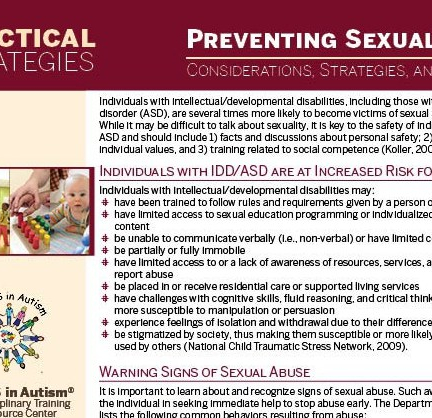
HANDS in Autism developed a handout with suggested strategies. Learn more at HANDSinAutism.iupui.edu

Additional Resources

References: