
Sexual Health Class Research Survey

Individuals with ASD rarely get sufficient and/or reliable information about healthy sexual behaviors from traditional sources, like at school or from parents/caregivers, which often results in an increased risk of becoming victims of sexual crimes or perceived offenders (Brown-Lavoie, Viecili, and Weiss, 2014). Reviews and research related to the sexual health curriculums used within schools or educational settings for individuals with ASD is sparse with some indication of the absence of any existing or adapted curriculum in regular use. Removal of these students from sexual health classes means they are left to obtain information from unmonitored sources.

This brief survey is designed to gain insight from a variety of stakeholders (i.e., family members/caregivers, teachers, school admin, or individuals with a disability) regarding sexual health knowledge and the programs provided within an educational setting for students with disabilities.

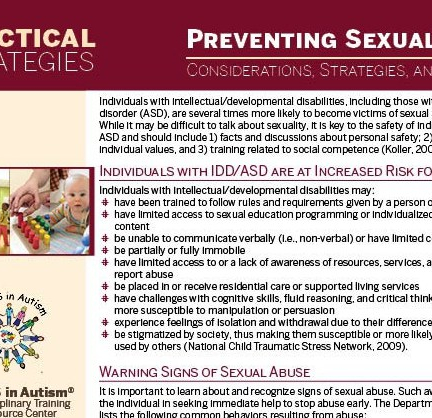
As a thank you for your participation, you will receive a PDF info sheet with practical strategies for providing resources and skills teaching materials related to sexual health as a step towards preventing sexual abuse or victimization of individuals with disabilities. Please consider sharing this survey with friends and colleagues alike.

Please contact Naomi Swiezy, Ph.D., HSPP, Director, HANDS in Autism® Interdisciplinary Training and Resource Center at nswiezy@iupui.edu or Tiffany Neal, Ph.D., Assistant Director, HANDS in Autism® Interdisciplinary Training and Resource Center at nealtiff@iupui.edu with any questions, concerns, or additional comments.
Applied Behavior Analysis (ABA)

On this page, you can explore the following topics (click on the topic of interest):

What is ABA?

Applied Behavior Analysis, or ABA, is a research-based philosophy of working with individuals of different abilities, not just individuals with ASD. ABA encompasses a range of strategies and methods based on standard behavioral principles designed to address reduction of behaviors by encouraging positive or desired behaviors and discouraging negative or unwanted behaviors in order to improve a variety of skills. Behaviors are considered to be a form of communication that can be addressed by teaching appropriate skills to support the reduction of undesired behaviors across settings.

Back to Top

Examples of ABA methods include, but are not limited to:

Back to Top

  • Incidental Teaching: Creating a learning environment based on an individual’s interests or motivations

Back to Top

Back to Top

  • Social Stories™: Using words and/or pictures to describe what to do in various situations that may challenge or provoke anxiety within an individual (developed by Carol Gray)

Back to Top

Additional Resources

Autism Speaks: Applied Behavior Analysis (ABA) www.autismspeaks.org/what-autism/treatment/applied-behavior-analysis-aba

Behavior Analysis Certification Board (BACB): About Behavior Analysis www.bacb.com/about-behavior-analysis/

HANDS in Autism® Interdisciplinary Training & Resource Center: Applied Behavior Analysis (ABA). What is it? HANDSinAutism.iupui.edu/autism.html 

Back to Top

ASD: Assessing Needs for Information and Training in Indiana

HANDS in Autism® at the IU School of Medicine has been invited to conduct an analysis of the current resources and services related to Autism Spectrum Disorder (ASD) in Indiana. The results of this analysis will help to inform the comprehensive plan for collaboratively and strategically strengthening the supports among systems for families and individuals with ASD.

One component of this analysis involves the completion of a comprehensive needs assessment. We are seeking input from all perspectives, whether as a family member, individual with ASD, medical provider, school personnel, justice system employee, or other community service provider. For this assessment to be representative of the many stakeholder groups that support individuals with ASD as well as reflective of the needs of individuals with ASD themselves, we need participation from as many people and from as many viewpoints as possible. All responses will be confidential and only summary data will be shared with the state and as part of the report and recommendations provided to the state.

Please take a moment to complete the survey and feel free to also share this information with others who may provide insight. The survey will take approximately 10- 15 minutes to complete. If you are interested in completing a hard copy survey or know of others who may be interested in completing a hard copy version of the survey, let us know as hard copies are available upon request.

To complete the Indiana Autism Needs Assessment, click on the following link:
English Version – http://tinyurl.com/autismneeds
Spanish Version – http://tinyurl.com/spanishautismneeds

Featured Presentations

Supporting Families through the LifeCourse with Julie Reynolds, DDRS

Insurance and Advocating with Michele Trivedi, The Arc of Indiana

Indiana Systems of Care: Strengthening Our Communities with Jayme Whitacker, FSSA, DMHA and Christy Gauss, IDOE